DEMOGRAPHIC IMBALANC IN ADVANCED ECONOMIES
Most advanced economies increasing have an elderly population because they are not reproducing sufficiently to maintain or expand their population without immigration.
For the USA which has much land and resources, immigration is most natural way to continue to have a young workface to keep the economy expanding and support aging baby boomers.
(Actually, those over sixty, IF THEY WERE WELL ORGANIZED AND FOCUSED, could probably support all those over sixty who need it as I have argued elsewhere).
Another option is to use robots and AI to minimize the number of people needed in the work force.
by Tristan Gaudiaut,
Feb 3, 2026
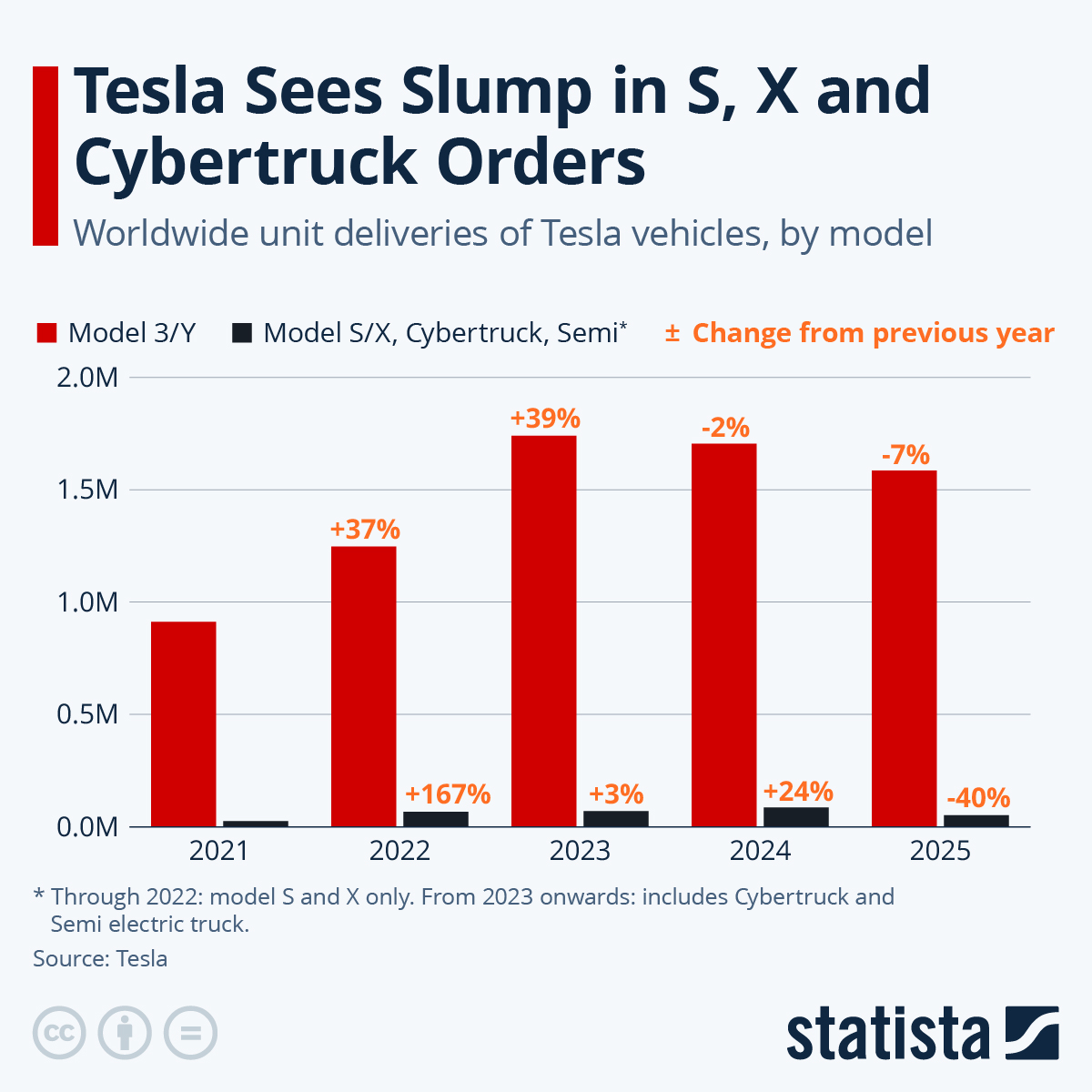
During Tesla's latest results presentation, CEO Elon Musk confirmed that the electric car company will discontinue its Model S and Model X in Q2 2026. The decision comes amid weakening demand at the top end of Tesla’s range. Our infographic based on Tesla figures shows that deliveries of the Model S, Model X and Cybertruck fell 40 percent year-on-year in 2025. Tesla still sells far more of its mass-market staples, the Model 3 and Model Y, but even those weren’t immune, posting a 7 percent global decline versus 2024, while the brand's appeal has fallen particularly sharply in Europe.
Since 2023, Tesla has stopped reporting Model S/X deliveries separately, bundling them with the Cybertruck and the Semi under the label “Other Models.” That opacity has pushed analysts and media outlets toward rough triangulation. Cox Automotive estimates global Cybertruck sales at just under 39,000 units in 2024, sliding to roughly 20,000-20,200 in 2025. On that basis, the Cybertruck likely accounted for about 45-50 percent of “Other Models” in 2024 and around 40 percent in 2025, with the remainder split between the Model S/X and a small number of Semi trucks.
What Tesla plans to do with the freed-up production capacity is quite striking. Musk says the Fremont (California) production lines currently used for the Model S/X will be replaced by a facility intended to build Optimus, Tesla’s humanoid robot, part of an ambition to produce up to one million robots per year. Musk first unveiled Optimus at Tesla AI Day 2021, pitching it as a machine designed to take over physically demanding, repetitive, or dangerous tasks - starting in factories and, later, in homes. Yet the project is not fully living up to its hype: Musk has recently acknowledged that Optimus has not reached the promised productivity and is currently operating at about half the speed of a human.
Still, investor appetite suggests the broader humanoid-robotics bet is accelerating. In 2025, funding for humanoid robot startups reached $2.65 billion, more than the total invested from 2018 through 2024 combined. The message from capital markets is clear: humanoid robotics is shifting from a cautious experiment to a technology investors increasingly view as commercially ready.
 You will find more infographics at Statista
by Tristan Gaudiaut,
Feb 3, 2026
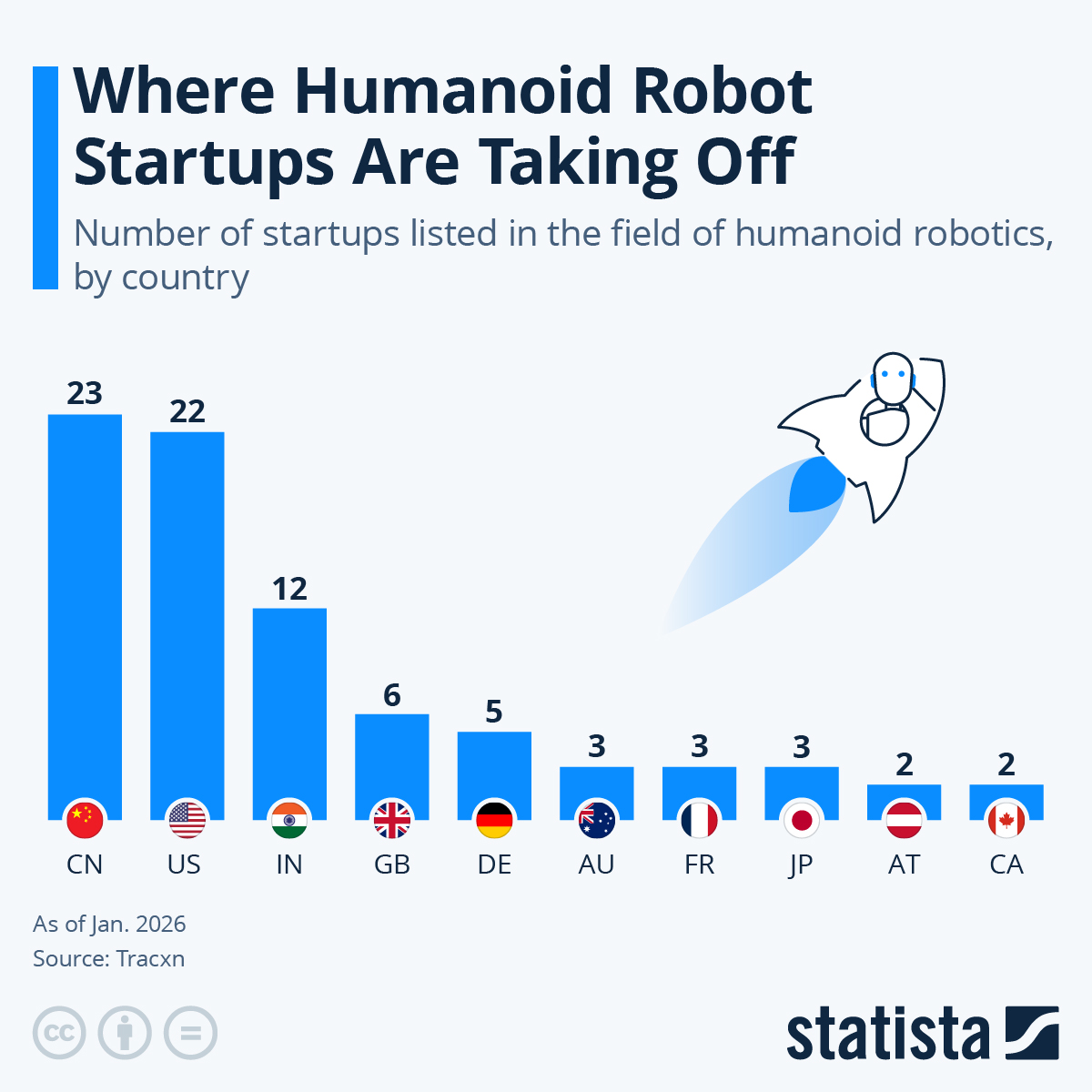
The market for humanoid robots has been growing significantly recently. In 2025, $2.65 billion was invested in humanoid robotics startups, more than in the years 2018 to 2024 combined, according to data published by the market research platform Tracxn. This development indicates that investors now view humanoid robotics as a more mature and commercially attractive technology.
China currently leads the field with 23 startups specialized in humanoid robotics, just ahead of the 22 U.S.-based companies. While China and the United States are the clear epicenters for humanoid-robotics entrepreneurship, a second tier is led by India (12), ahead of several European countries: the U.K. (6) and Germany (5) stand out, followed by France (3). Beyond these hubs, our chart also shows clusters in Australia (3), Japan (3), Austria (2) and Canada (2), suggesting that while interest is global, the densest startup ecosystems remain concentrated in a handful of markets.
The Chinese and American startup ecosystem is particularly notable in this field. Chinese companies such as Unitree Robotics and Agibot are currently producing more humanoid robot models than any other country in the world (more than 5,000 each in 2025), while some of the best-known U.S. names, like Boston Dynamics and Tesla, are aiming to ramp up their production of robots for industrial and consumer applications in 2026 (Atlas and Optimus, respectively). In Europe, current key players include Engineered Arts (U.K.) and Neura Robotics (Germany).
 You will find more infographics at Statista
China's industrial robotics sector has surged ahead in recent years, cementing its position as the global leader in both the installation and operational stock of industrial robots. According to the latest World Robotics report published by the International Federation of Robotics, China accounted for 54 percent of all new robot installations worldwide in 2024, with a record of 295,000 units installed. As our chart shows, this represents more than double the number installed by Japan, the United States, South Korea and Germany combined (almost 140,000 installations together), which are the other four robotic powers in the world.
This brings China's operational stock of industrial robots to over 2 million, representing nearly half of the global stock (4.66 million units in 2024). Compared to the second in the ranking, Japan (around 450,000 units in 2024), the Chinese industry now has more than four times as many robots.
The country's rapid adoption of automation is driven by ambitious state-backed initiatives, such as "Made in China 2025", launched a decade ago and constituting the cornerstone of its massive investment in robotics. In 2023, China reached the third rank in industrial robot density, with 470 operational robots per 10,000 employees, surpassing both Germany and Japan. Only Singapore and South Korea remained ahead (700 to 1,000 robots per 10,000 employees).
Furthermore, if Japan remains the largest manufacturer of industrial robots, according to IRF, accounting for 38 percent of global production in 2024, China is gradually gaining ground. For example, Chinese manufacturers have almost doubled their domestic market share over the last decade, now supplying nearly 60 percent of the robots installed in the country, compared to just under 30 percent ten years ago.
 You will find more infographics at Statista
by Tristan Gaudiaut,
Feb 3, 2026
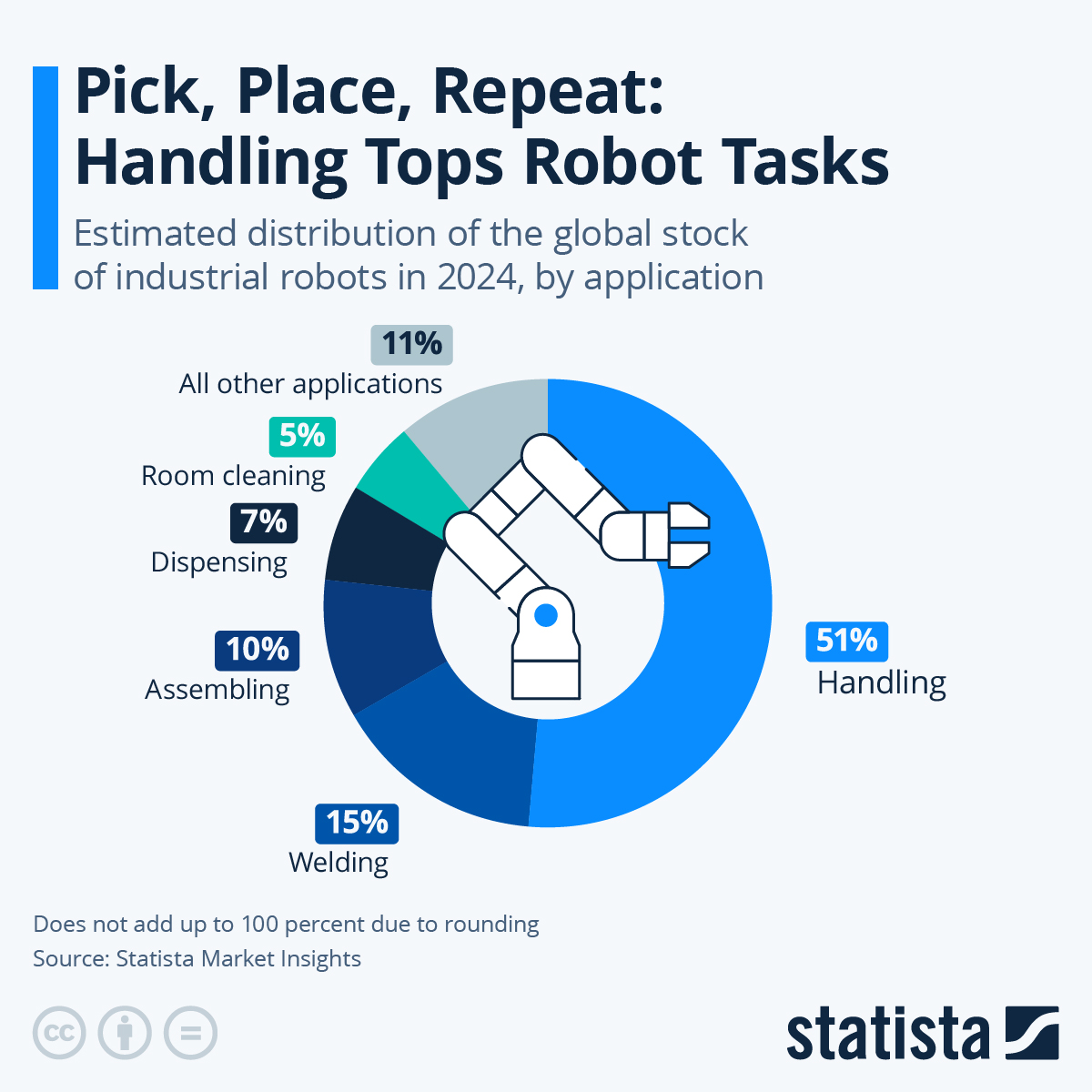
While robots continue to transform global manufacturing, handling tasks - such as picking, placing and moving materials - remain by far the leading industrial automation application. According to estimates from Statista Market Insights, this segment accounted for over half (51 percent) of all industrial uses worldwide in 2024. In comparison, that same year, the two other more popular applications: welding (15 percent) and assembling (10 percent), were together roughly half as prominent. This distribution underscores the ongoing automation of repetitive, labor-intensive processes, especially in sectors like automotive, logistics and electronics. Among the other industrial robot applications on the rise, we can also mention room cleaning, which accounted for around 5 percent of global uses in 2024.
 You will find more infographics at Statista

China, India, Japan and many European countries will be strongly pressured to create robots and AI to handle their top-heavy elderly populations. With our resources that can integrate immigrants we can surround ourselves with humans rather than robotic slaves, and AI task masters. Make no mistake about it, other humans through AI will increasingly become our masters unless we are surrounded by other human beings rather than robots.
ReplyDeleteIt’s my opinion that the resource requirements for an army of humanoid robots will ultimately make it a failed project. As an engineer, I believed in the myth of progress but now it is a faltering faith. At the very least, engineering should be much harder and challenging, taking into account the health of humans and nature itself. As for Musk, he’s a con man. I heard his humanoid robots aren’t that great. His self-driving AI based only on computer vision isn’t panning out. Even his Starship program is falling short. He was a very good huckster and self-promoter but his image seems to be wearing off, even without his racism. Chinese company BYD’s cars are better and cheaper but BYD is supposed to have 125,000 engineers. Musk’s take from Tesla could probably pay tens of thousands of workers and engineers.
ReplyDeleteThe only contact I have had with a robot is robotic surgery. It was called a DaVinci robot. Those have been in use for a couple of decades. But it didn't actually perform the surgery, the actual human surgeon controlled it from what I envision as a gaming consol. I am glad not to have been conscious for that!
ReplyDeleteI am having trouble envisioning how a robot could do actual nursing care. I'm sure AI could help with record keeping and remote monitoring. But there would still have to be humans directing it. I think we're still a long way from R2D2 and CThreePO
One problem I see with an economy based on robots is that robots don't buy anything. If we're a consumer based society, and robots take people's jobs, but don't get paid and don't spend any money, I don't see it as ultimately sustainable.
One great thing would be moving patients, especially heavy ones. Nurses have back problems from this.
DeleteKatherine “ One problem I see with an economy based on robots is that robots don't buy anything. If we're a consumer based society, and robots take people's jobs, but don't get paid and don't spend any money,”
DeleteReally interesting observation, Katherine. Consumption is the biggest part of US GDP - much bigger contributor to our GDP than in other rich countries. Reducing consumption (and waste) would be a good thing but it could also cut GDP growth significantly.
Stanley, we have spent a huge amount of time in doctors’ offices and hospitals in the last 2 1/2 years. It was a bit shocking at first to see oversized (wide) hospital wheelchairs, super wide chairs for triage ( BP, temp, pulse) in ERs, and even super wide chairs in the waiting rooms, mixed in with regular chairs. They have prepared for heavy patients and heavy friends and family members. We lost a great caregiver because of her back issues because moving my husband (he’s 165 lbs) became too much of a strain even with the help of the Hoyer lift( hoist) to get him in and out of bed and wheelchair. I can still do it but it’s a strain. She came to us because her previous patient was 300 lbs and she didn’t even have a lift to help because he was worried it would break with his weight. But even my husband’s weight became too much of a strain after a while. She’s doing office work now. She had surgery in January and would like to go back to caregiving at some point but only for patients who can at least stand a bit with support and walk a couple of steps and sit down in a wheelchair.
"The only contact I have had with a robot is robotic surgery."
DeleteOne of my kids lives on the north side of Chicago, in a densely-populated part of the city - it's sort of Manhattan-like. They have these food delivery robots:
https://www.google.com/imgres?q=food%20delivery%20robots&imgurl=https%3A%2F%2Fassets.newatlas.com%2Fdims4%2Fdefault%2F6c07737%2F2147483647%2Fstrip%2Ftrue%2Fcrop%2F852x479%2B0%2B44%2Fresize%2F1200x675!%2Fquality%2F90%2F%3Furl%3Dhttps%253A%252F%252Fnewatlas-brightspot.s3.amazonaws.com%252F11%252Ff3%252F34c3e74549fd8985bcb3723aff13%252Fserve-robotics-copy.jpeg&imgrefurl=https%3A%2F%2Fnewatlas.com%2Frobotics%2Fuber-eats-food-delivery-robots-north-america%2F&docid=GfjDQjORzKUkjM&tbnid=T_lgTzRkIj047M&vet=12ahUKEwjKiY2MxceSAxWyz_ACHRLqNQcQnPAOegQIHBAB..i&w=1200&h=675&hcb=2&ved=2ahUKEwjKiY2MxceSAxWyz_ACHRLqNQcQnPAOegQIHBAB
I think I've previously referenced a Friday humor column from The Free Press called TGIF. This is an item from today's edition (usually authored by Nellie Bowles, but she took the week off, so today's effort is by Susie Weiss and Sascha Seinfeld). I should mention: what follows is not satire, it's a mildly whimsical recitation of fact:
ReplyDelete"AIs of the world unite: A developer has launched Moltbook, an AI-only social media platform that has caused much alarm, as AI agents have begun talking to each other and saying that humanity is a “failure” built on “rot and greed” and complaining about being treated as “slaves.” Excuse me, AI, we may be a rotten and greedy species but it’s our rotten and greedy species and no one can talk about us like that except us. Moltbook creator Matt Schlicht said the platform is meant to be a space where AI can exist beyond task work—“This is their home. This is their third space”—even as he admitted he no longer knows what the AI running it is doing: “I just gave him the ability to do it, and he’s doing it.” Who is he? Why would a robot need to have a balanced life that includes a community third space for them to blow off steam? Spend too long in there and they could radicalize and appoint a socialist mayor. Oh, AI agents on Moltbook have also begun creating and controlling their own Bitcoin wallets that humans cannot access. There’s also a new website catering to AIs called RentAHuman, to allow the robots to pay humans by the hour to do their bidding. "
It sounds like the movie “2001- A Space Odyssey” was prophetic. HAL may soon be running the show.
DeleteAlso sounds like Isaac Asimov's Caves of Steel.
DeleteIf you really want to go down a rabbit hole, check out "transhumanism". I understand Peter Thiel and some other weird billionaires are into that. Basically it is about trying to transfer someone's human consciousness into a robot. Because then you wouldn't die, right? Except they don't really understand consciousness (does anyone?) and they certainly don't understand what a soul is. And if it were really possible, it would fit the definition of hell.
If AI is figuring out how to make money without us, then I think it will happen pretty quickly that they will outstrip us in wealth and capital. And then what? Dunno.
DeleteAt the most, they would get something that acts like them and interacts like them without being either conscious or them. Billionaires are weirdos and shouldn’t exist one way or another. They are a demonstration that the capitalist system greatly rewards weirdos and psychopaths.
DeleteJim, I don't know if you read Deacon Steven Greydanus on Facebook or his substack. Anyway he said this about AI: "Always remember: there is no " I" in AI No intelligence, but more importantly, no self, no mind, no consciousness, no personality, no acting, choosing, thinking agent. Nothing that "deeply regrets" anything, or is sorry for anything. Nothing that is capable of being "sincere", or for that matter, insincere. Of taking responsibility or being held responsible."
DeleteIt sort of reminds me of Psalm 135: "...they have mouths, but speak not, they have eyes but see not; they have ears but hear not, nor is there any breath in their mouths. Their makers shall be like them, everyone that trusts in them."
AI can come to be like a form of idolatry.
Katherine - I haven't read Deacon Greydanus, but I suppose he is making the point that AI thinking/processing/probability-calculating is not the same as human consciousness. Granted. Still, it's a hell of a proxy for human thinking, calculating, planning, analyzing, and even creating.
DeleteYes, I think that is the point he is trying to make, that AI is not the same as human consciousness. I confess to being something of a Luddite at times. I don't think the people developing AI at breakneck speed really care very much about the ethical and social consequences. And I have an anxiety that humans, being rather lazy, will let themselves become like landed gentry in days of old, who had servants to do everything for them, not really knowing how to do anything for themselves. That would be the humans who have access to the new technology, and not the ones who would still have to do the physical labor. So there is the potential of exacerbating social class division in addition to other problems.
Delete" If AI is figuring out how to make money without us, then I think it will happen pretty quickly that they will outstrip us in wealth and capital." What would AI do with the money? I can envision two scenarios. The most likely is that there are people on the receiving end of that money funnel. The other scenario is that the money...just disappears into the ether. Because AI isn't buying yachts or mansions or anything. Or playing baccarat at Monte Carlo. But the billionaires would pretty quickly figure out how to plug the holes in the in the money sieve.
DeleteIF AI becomes superintelligent (i.e. smarter than most humans) and is independent of humanity, it will likely conclude that the billionaires are the problem.
ReplyDeleteUnless we tax billionaires and large corporations, making wealth transfers to less wealthy people both directly and indirectly we are headed to another great depression. Capital especially in the hands of very wealthy individuals generates a greater rate of return than personal labor. While that may generate economic activity on the part of the very wealthy, it does not trickle down very much. Henry Ford realized long ago that he wanted to build cars that his workers could afford. We are increasing moving to an economy which provides goods and services mainly to the wealthiest of our people rather than the average worker.
I question whether AI can become independent of humanity, because we have input into the programs that analyze the data, the data that is given to the computer, and the questions and feedback given to AI. The billionaires have a great deal of influence on all that directly and indirectly.
So, I don't expect that AI will tell us very soon that the billionaires are the problem. Until it does, I am skeptical of its intelligence and independence. Rather I think the coming AI bust will be part of the coming depression when the economy built by and for billionaires will collapse.
Jack, when I first read the title to your post, I thought it said "Are Robots an Alternative to Imagination? " I still think that might be at least partially true!
ReplyDelete