Monday, August 6, 2018

Taking a brief break from junk reading...

Ezra Klein at Vox has this today:

Amusing ourselves to Trump

We  are buried under ignorance disguised as information.

Nothing that hasn't been said here before, but a good comparison with Orwell and Huxley's metaphors back in the days of fascism.


First as tragedy, then as farce


As collective bargaining has been rolled back, efforts to suppress voting have returned, inequality has grown, and unregulated big money again dominates politics.
  I don't read any long articles on line, so I didn't see this until the August 10 issue of Commonweal arrived on old fashioned but much-appreciated paper. The quote is from Joseph A. McCartin's piece on the most recent mortal threat to labor unions. That would be Justice Sam Alito's 5-4 essay that effectively kills the states' power to make non-union employees to pay a fee (less than full dues) to unions for negotiating labor contracts covering them.

 Just another nail in the coffin of our democratic republic. If it is to be saved, there are exciting times ahead. I am almost sad to know I won't be around to see how it is done  and maybe help to do it.


Sunday, August 5, 2018

Summer reading: Domestic thrillers

Image result for cover art the hours before dawn
I presented a paper a few years ago on domestic thriller novels, mentioned in a previous post. The paper started like this:
Betty Friedan’s “problem that has no name” in The Feminine Mystique (1963) was the central issue of the Second Wave feminist movement. But before publication of Friedan's book, her “problem” had been pretty thoroughly worked over in the previous 15 years in popular domestic thriller novels written by women. Between 1946 and 1963, many first-rate women novelists in the U.S. and Britain were writing in this genre (also called domestic suspense or, more lately, chick noir). Patricia Highsmith, Shirley Jackson, and Daphne DuMaurier are still popular, but Vera Caspary, Valerie Taylor, Evelyn Piper, and others are less well known, and many of their works are out of print. However, all these writers were fascinated by the way post-War domesticity in white suburbia might drive women to insanity and crime, even as The Adventures of Ozzie and Harriet was telling women that they were lucky to be living a life of domestic order and comfort with their time-saving Hotpoint appliances.

Friday, August 3, 2018

The tension in the church's death penalty teaching

As Tom reported yesterday, Pope Francis has declared that the death penalty is "inadmissible because it is an attack on the inviolability and dignity of the person."   I'd like to take take a look at the Catholic church's teaching on the death penalty in the two most recent revisions of the applicable paragraph in the Catechism of the Catholic Church.  I'll try to identify the underlying principles present in those paragraphs, and touch on a tension that seems to be present in those syntheses.

Thursday, August 2, 2018

Who will bear the tidings to the Supreme Court?

 The Church changed its teaching on capital punishment. I heard that this morning on NPR in a report that didn't say how or who said so. But the story turned out to be true enough when I chased it down on Zenit. And The Guardian even treated the news as a "challenge" to President Trump and a stumbling block to future  Vatican relations with China.
  It isn't going to be good news to a lot of American Catholics, either.
  The change is a new paragraph 2266 of the Catechism of the Catholic Church. Capital punishment has been a big problem for that book. The first edition of the Catechism allowed the death penalty if proper authority said it was needed. But then Pope John Paul applied brakes to that. The now-sainted pope said yeah, proper authority could use the death penalty if it had to, but there are hardly any conditions -- "rare, or non-existent" -- in the modern world when it would have to. That is how execution stood in more recent editions.
 Pope Francis removed the qualifiers, and the Catechism now says:
 
2267. Recourse to the death penalty on the part of legitimate authority, following a fair trial, was long considered an appropriate response to the gravity of certain crimes and an acceptable, albeit extreme, means of safeguarding the common good.
Today, however, there is an increasing awareness that the dignity of the person is not lost even after the commission of very serious crimes. In addition, a new understanding has emerged of the significance of penal sanctions imposed by the state. Lastly, more effective systems of detention have been developed, which ensure the due protection of citizens but, at the same time, do not definitively deprive the guilty of the possibility of redemption.
Consequently, the Church teaches, in the light of the Gospel, that “the death penalty is inadmissible because it is an attack on the inviolability and dignity of the person”, and she works with determination for its abolition worldwide.
Wednesday, August 1, 2018

A pledge of commitment - Updated


Update 8/3/2018 11:01 pm - Cardinal DiNardo, president of the USCCB, has issued a statement on the McCarrick controversy.  Scroll to the bottom of the post for more details.

-----

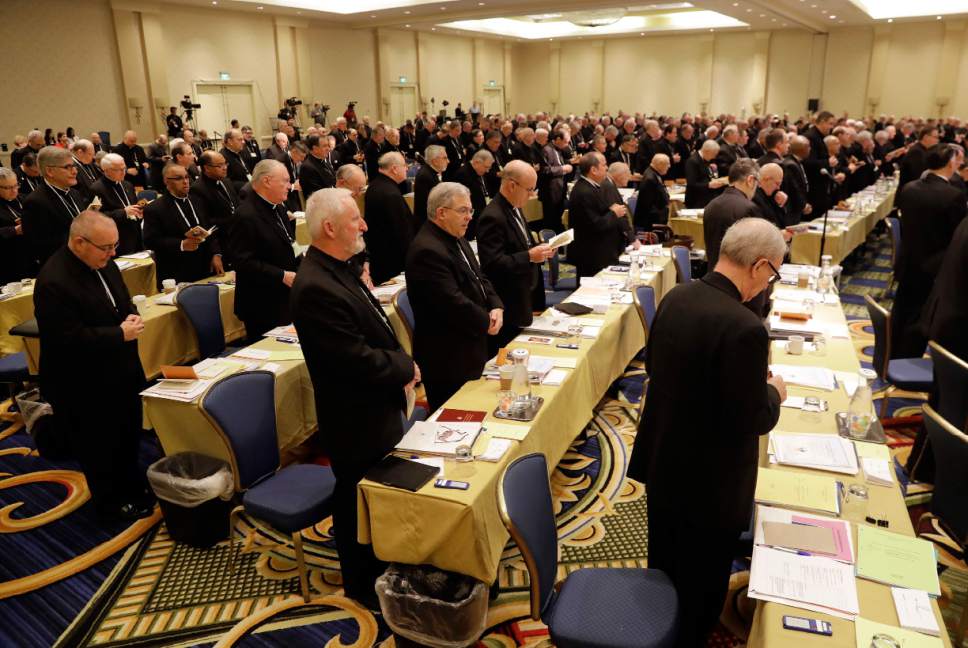
Less than two months ago, the American bishops reviewed and revised the documents known collectively as the Dallas Charter.   Those Charter documents include some specific promises by the bishops to hold one another accountable.  Their promises unexpectedly became both pertinent and important when, within a week of the Charter's revision, Cardinal McCarrick's allegedly abusive past was made public.   We hope and pray that the contents of the Charter documents are still fresh in the bishops' minds, because the church now looks to them to keep their promises.

Saint for the Abused

This article on the Commonweal site by B.D. McClay is worth reading, in view of our recent discussion of abusers in the Church.
Those of us who grew up Catholic in the 1950s and '60s are well acquainted with the story of St. Maria Goretti, who was canonized in 1950 by Pope Pius XII. As a girl, I had mixed feelings about her.  I respected her piety and virtue. But the main message I got from her story was that it was dangerous to be a girl.  My parents must have picked up on my uneasiness, or maybe they had some uneasiness themselves. I remember my dad saying something like, "I would rather have a living daughter than a dead saint."  And my mother's opinion was that Assunta, Maria's mother, was pretty clueless not to have know that Maria's attacker, Alesandro Serenelli, was up to no good.  "I'd have sorted him out with a 2 -by-4 before it ever got to the point that it did.  And then I would have taken my kids and left."  And she would have, too.  I was comforted by her reaction; but even then I knew that she had never been as disempowered as Maria's mother had been. We had never known life without a safety net, as they had.