The safety advantages of Waymo self-driving vehicles are impossible to ignore.
Tuesday, December 9, 2025
Monday, December 8, 2025
Leo and Chant
When B16 became Pope, I hoped that he would help popularize Latin hymns and chants in the Liturgy. What he did was divide the Church with the Extraordinary Form.
Leo who can sing, may be doing what I hoped that B16 would do. Be inviting the people to sing the Regina Coeli rather than saying it or the Lord's prayer he has quietly begun to welcome Latin hymns and chants into the mainstream of the Church. They have always been there even under Francis, but they were mostly sung by the Sistine Choir. Leo is saying that these are for everyone, not simply elite singers.
The Pontifical Institute has put out a series "Singing with the Pope" which helps people to understand the Latin responses at a papal mass. This is Vatican II, full and active participation in the Liturgy, in this case in Latin. Here is the beginning of Mass
This is absolutely brilliant. It both brings Latin chant into the mainstream of church life, and quite possibly those who might be attracted to the Extraordinary Form of the Liturgy.
The National Catholic Reporter has republished a great article on the scientific benefits of singing.
As a performing artist and scientist of human movement, I spent the past decade developing therapeutic techniques involving singing and dancing to help people with neurological disorders. Much like the pope's initiative, these arts-based therapies require active participation, promote connection, and are accessible to anyone. Indeed, not only is singing a deeply ingrained human cultural activity, research increasingly shows how good it is for us.
This article is republished from The Conversation under a Creative Commons license. Read the original article.
Elinor Harrison is a lecturer in the Performing Arts Department and faculty affiliate in philosophy-neuroscience-psychology at Washington University in St. Louis. She received funding from the National Institutes of Health, the National Endowment for the Arts and the Grammy Museum Foundation. She is affiliated with the International Association of Dance Medicine and Science and the Society for Music Perception and Cognition.
Tuesday, December 2, 2025
Pope Leo's message on AI
I thought this message by Pope Leo on AI was really good, and I have included most of it here, the conference took place in June:
"On the occasion of this Second Annual Rome Conference on Artificial Intelligence I extend my prayerful good wishes to those taking part. Your presence attests to the urgent need for serious reflection and ongoing discussion on the inherently ethical dimension of AI.....
Monday, December 1, 2025
How Accurate are AI Chatbots?
STATISTA: How Accurate are AI Chatbots?
by Tristan Gaudiaut,
Nov 28, 2025
Three years ago, on November 30, 2022, the official release of ChatGPT marked a turning point in artificial intelligence, propelling AI chatbots (or large language models) into the mainstream. Since then, progress has been undeniable: LLMs' ability to process complex queries, summarize vast amounts of information and even assist in coding has improved considerably.
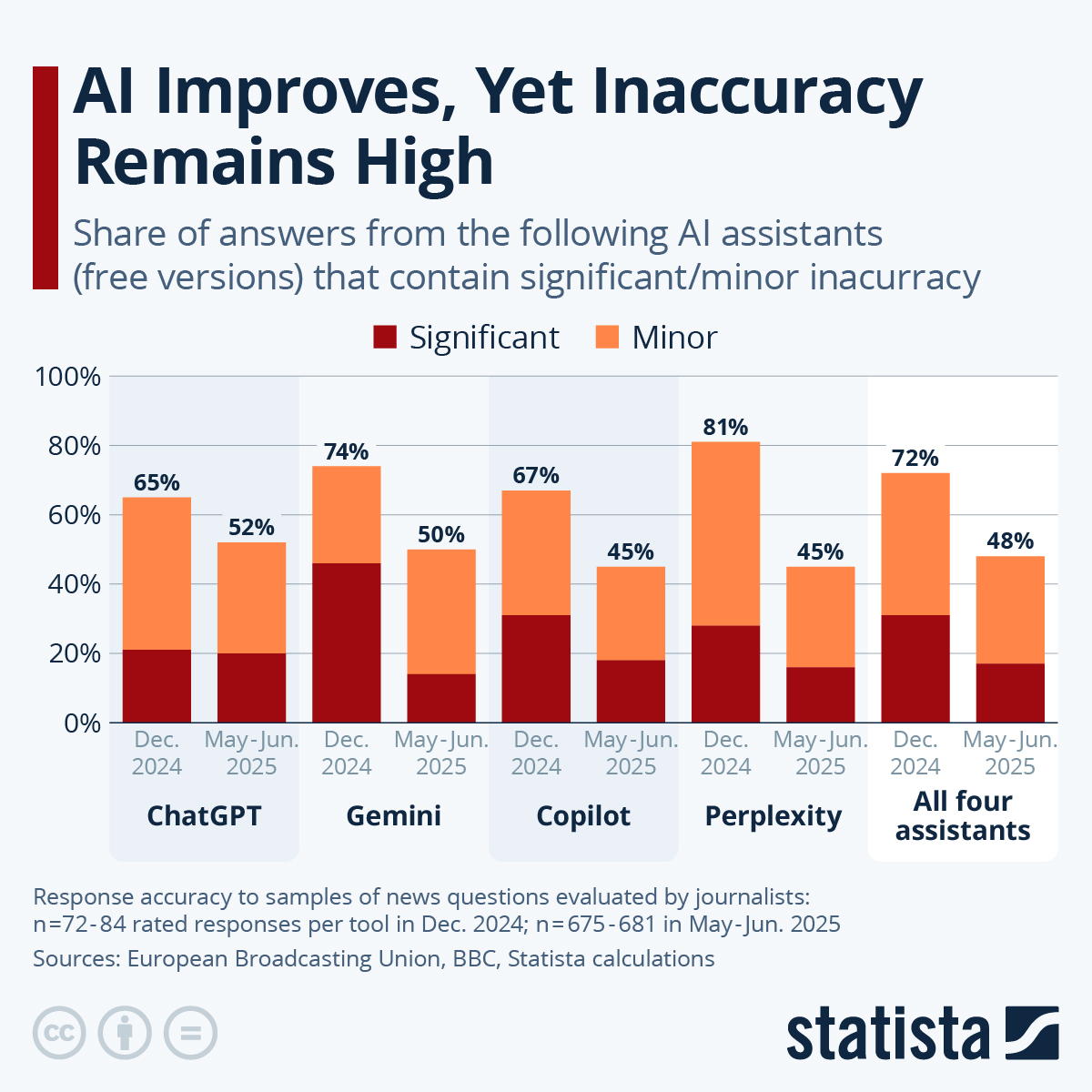
Yet, hallucinations, misinterpretations of context and inaccuracies continue to plague even the most sophisticated of currently available models. A study from the European Broadcasting Union and the BBC reveals that while the rate of inaccurate responses has declined since the end of last year, errors continue to be widespread.
Data collected between May and June 2025 and analyzed by a cohort of journalists revealed that almost half of the responses (48 percent) from popular chatbots - free versions of ChatGPT, Gemini, Copilot and Perplexity - contained accuracy issues. 17 percent were significant errors, mainly regarding sourcing and missing context. In December 2024, the rate of inaccurate responses (observed using a smaller answers sample) was significantly higher: 72 percent for all four LLMs. 31 percent were major issues in that case.
Despite gradual improvements, these shortcomings raise critical questions about reliability, especially in high-stakes applications like healthcare, legal advice or education. While AI developers keep pushing boundaries, users must remain aware of the technology's current limitations.
 You will find more infographics at Statista